Rethinking How We Address Gendered Workplace Violence in Primary Healthcare Settings: A Dialogue with Abi Badru
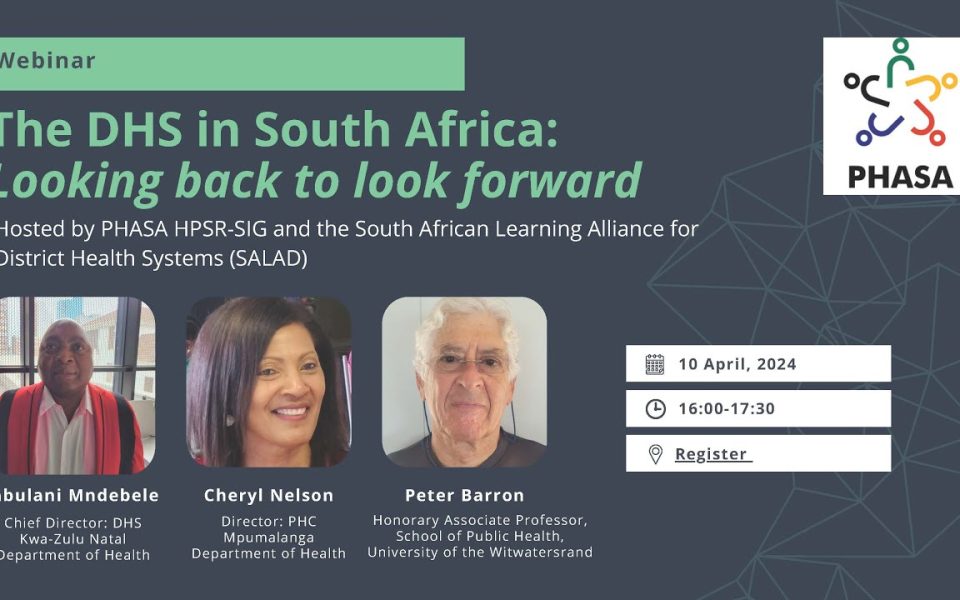
12 May 2026The DHS in South Africa: Looking back to look forward (April, 2024)
28 May 2026
Rethinking How We Address Gendered Workplace Violence in Primary Healthcare Settings: A Dialogue with Abi Badru
12 May 2026The DHS in South Africa: Looking back to look forward (April, 2024)
28 May 2026
Public Health Association of South Africa (PHASA) Health Policy and Systems Research
The DHS in South Africa: Looking back to look forward
WEBINAR SUMMARY
10 April 2024
This webinar was hosted by PHASA HPSR SIG and SALAD during Global Health Week (8-12 April) as part of PHASA advocacy activities under the World Federation of Public Health Associations.
According to the WHO, a DHS is a self-sufficient segment of the national health system, consisting of all the individuals and organisations providing care to a well-defined population in a clearly delineated geographical area. In South Africa, the DHS is the foundation of the health system, and the primary mechanism for the delivery of primary health care (PHC).
This webinar offered a historical account of the development of the DHS in South Africa, explored challenges and opportunities, and concluded with a discussion on the importance of the DHS in light of the country’s ongoing health reforms.
The history of DHS in South Africa: Presented by Peter Barron and Eleanor Whyle
The 1994 ANC Health Plan committed to addressing fragmentation and inequity by establishing a unified National Health system and decentralising authority to the lowest possible level. The South African health system would be based on a PHC approach with the DHS, congruent with local government boundaries, as the primary mechanism for delivery of PHC. The process of establishing the DHS required delineating districts in a context of emerging local government boundaries and developing decentralised management and service delivery capacity in the post-apartheid political dispensation. The alignment of health districts with local government boundaries was intended to facilitate intersectoral collaboration, but it also gave rise to significant variation in the size of the populations in different districts, and relatively large districts compared to the WHO ideal (with South Africa’s sub-district’s more closely resembling the WHO’s districts). Initiatives to build capacity at the district-level included the Equity Project to promote the use of health information in management, and the Initiative for Sub-District Support (ISDS) to support district and sub-district management teams. The National Health Act of 2003 formally established the DHS, made provision for the division of districts into sub-districts (to address the significant variation in district size and align with WHO principles), for the establishment of District Health Councils to promote cooperative governance and ensure coordination in the planning, budgeting and monitoring of health, and mandated local government to ensure that ‘municipal health services’ are equitably and effectively provided. In this period, however, the development of the DHS was slowed by, among other factors, the HIV epidemic, which dominated the health at the expense of broader system strengthening.
Beginning in 2010, the process of establishing a NHI in South Africa has resulted in renewed attention and energy to strengthening DHS. These efforts included the establishment of NHI pilot districts, the adoption of the PHC re-engineering strategy – including the establishment of school health services, ward-based PHC outreach teams (WBPHCOTs), and district-based specialist teams. Under NHI, it is envisaged that sub-district based contracting units (CUPs) will receive funds from the national NHI fund and will contract public and private providers to deliver PHC services to the district population.
The Provincial perspective: A round-table discussion with special guests Jabulani
Mndebele and Cheryl Nelson, facilitated by Lucy Gilson
What has been achieved in terms of DHS development from the provincial perspective?
The round-table discussion began with an exploration of the progress made in DHS development in Mpumalanga and KZN. The speakers and participants agreed that a lot has been achieved across all elements of the health system – particularly decentralisation and delegation, and intersectoral development – which has contributed to tangible gains in health outcomes.
Cheryl Nelson, Chief Director for PHC in Mpumalanga, gave an overview of the significant progress the province has made in developing the DHS in the province. Following the approval of the DHS policy in 1996, the Provincial Department of Health, Welfare and Gender Affairs published the ‘purple book’, officially entitled “Primary Health Care in Mpumalanga: Guide to District-Based Action” to strengthen district-based PHC. Since then, the province has implemented a range of district-strengthening interventions.
With respect to service provision, in order to meet the needs of the expanding population, the province has substantially increased the number of hospitals and clinics, more than doubled the number of Community Health Centres (CHCs), and extended clinic operating times. In line with the national PHC re-engineering strategy, the province has established 253 WBPHCOTs, extended the school health programme with the addition of 76 professional nurses, provided stipends for 5348 CHWs, established youth zones in 230 (of 292) clinics as part of the Youth and Adolescent programme. There is now an EMS manager in each district, and the province is implementing a planned patient transport policy. The province has also improved district-level health infrastructure, using District Health Expenditure Reviews (DHERs) for planning. Webinar participants agreed that the DHER has been a valuable tool in addressing the hospi-centric nature of the health system, and improved the allocation of resources to clinics and CHCs. With respect to quality assurance, all new facilities have been constructed using the clinical brief, clinical governance guidelines are in place, and quality learning centres have been established based on the national quality improvement plan.
Jabulani Mndebele, Chief Director for DHS in KwaZulu Natal, reviewed the progress made in the province. He noted that, in KZN, the definition of the DHS has been expanded to span all health services, including all hospitals (not just district hospitals), forensic services and EMS. The province has 11 well-established districts, with fully-functional DHMTs, which meet on a monthly basis and responsible for planning and M&E. All clinics have been provincialized, with the exception of those managed by the Metro. There are 10 200 CHWs working in the province, and the ideal clinic and ideal hospital policies are being implemented. With respect to the health workforce, all districts have been delegated authority to appoint and recruit staff, and the province has established regional training centres which focus on community development. Financial responsibility is delegated to district-level up to R1 million.
The province also developed an integrated health promotion and wellness strategy that includes all departments, and established the very successful Operation Sukuma Sakhe (OSS) to encourage and enable intersectoral collaboration and community participation. A webinar participant added that intersectoral collaboration includes a wide range of stakeholders, including mining companies and Development Trusts, which support programmes such as mental health, school health and eye health.
What are the remaining challenges with regard to DHS development and functioning?
Participants went on to explore some of the remaining challenges facing DHS development and functioning.
These included:
- The slow pace of legislative
- Human and financial resource shortages, and incomplete delegation of authority.
- Community participation and bottom-up accountability
- Integration of services
- Health information systems and management
- Broader societal issues
Lessons for future stewards of the DHS
Finally, participants collectively generated a set of key lessons for future stewards of the DHS. These included:
- Maintaining a person- and community-centred PHC orientation
- Focusing on sub-district development
- Building information infrastructure and using data to make decisions
- Developing a fit-for-purpose health workforce